Sunday, 29 March 2020

Money Lesson learnt from Convid19


 STEPS TO STAY AFLOAT AS COVID-19 STRIKES
Financial Planning to be secure at the time of any emergency


Extract from India Today Magazine 
Create a Emergency Fund


Keeping aside some  money for emergencies, such as unforeseen expenses or a sudden, even temporary, loss of income. Financial planners advise three to six months’ worth of expenses in cash or near-cash liquid assets. 
The idea is simple: this money should be available to you at very short notice, so liquidity is of the essence. 
Employees in highly vulnerable sectors such as aviation, hospitality, travel and tourism might like to set aside more. These are very uncertain times, so even 9-12 months’ expenses [can be parked in contingency options]
 Have health insurance


You do, however, need to set aside money for a health emergency in the family; Rs 5 lakh might serve. Not buying health insurance is not a risk you should take, because the annual premium on an insurance cover is a small fraction of what your hospital bill might be, if you have to be admitted. 
The right mutual fund for you
In times of great uncertainty, the stock market tends to go berserk. Stocks of good pedigree also get hammered, but seasoned long-term investors see that as an opportunity to pick up undervalued stocks. For those who lack the expertise, or the time or inclination to make individual stock picks, diversified equity funds or index funds are the way to go. They usually deliver returns that comfortably beat inflation and are easily the most transparently regulated investment avenue for inexpert, passive investors seeking long-term returns. Those who want to play it safe could look at large-cap index funds or large-cap funds
For further discussion
Feel free to contact
Pankaj Bhanwani
pankajbhanwani@gmail.com


Saturday, 28 March 2020

Production Possibility Curve Class 11 Economics

Class 11

2020-21

CBSE

@copyright


Practice Worksheet

Note to teachers - After teaching the lesson on production possibility curve the teacher can give them as a homework and can be checked and assessed


Chapter - Production Possibility Curve

Q1 Define PPC
________________________________________________________________________________________________________________________________________________________________________________________________________________________________________________________________________________________________________________

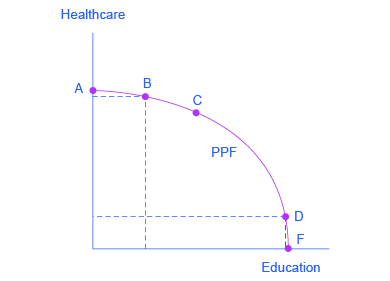
Q2 Complete the diagram 


Q3 Lets now identify the points on/off the PPC

  1. Point B in the diagram shows that more of ________ is produced and less of ________ is produced
  2. Point C in the diagram shows that more of ________ is produced and less of ________ is produced
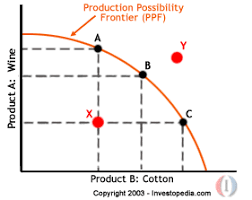
  3. Point X cannot be attained because it shows __________ of resource


Q4 What determines the shape of PPC


Q5 Its shape is _________  to origin

Q6 Lets now draw a schedule for PPC

Combination
Good X
Good Y
A


B


C


D


E


Q7 In the given diagram answer the following blanks
  1. Point X shows _____________________  use of resources

  1. When we move from point X to A more of __________ is produced and same amount of cotton
  2. When we move from point X to C more of __________ is produced and same amount of 
Wine

  1. When we move from point X to B more of __________ is produced and more of _______ is produced
  2. All the points on the PPC that is point A,B and C shows ___________  use of resources

Q8 The formulae for MOC is

 (-) Loss in -----------Gain in ----------


The negative sign in the formulae shows that PPC is _______________   sloping in nature

Q9 Give me 3 reasons why the PPC will shift outwards


Q10 You as a student has a limited resource as time . You have 8 hours of study . You are  can do 5 questions per hour of science and 2 questions per hour of maths Plot the different combination in a form of graph of PPC


What is the shape of PPC in this shape


Thursday, 26 March 2020

Organic Farming Class 12 CBSE Rural Development Activity Based Learning


Organic Farming

Class 12

CBSE

@Copyright Pankaj Bhanwani


Handout

Activity based learning – Read the article given below and answer the following questions


Source – The Hindu Business Line
Date March 25/03/2020

#Agriculture
#Rural Development
#growth
#lesson


Q 1 What are organic products?
___________________________________________________________________________________________________________________________________________________________________________________________________________________________________________________

Q 2 Because of Convid-19 less people are going  to _________________  demand of outside ____________  has _________   down

Q 3 What are the two reasons for increase in demand of organic products
___________________________________________________________________________________________________________________________________________________________________________________________________________________________________________________

Q 4 What are the drawback of using an organic product
___________________________________________________________________________________________________________________________________________________________________________________________________________________________________________________

Q 5 Mainly ___________ cities are demanding organic products

Q 6 Which could be a factor which lead to increase in demand of its product
___________________________________________________________________________________________________________________________________________________________________________________________________________________________________________________

Q 7 What business strategy is adopted by these firm
___________________________________________________________________________________________________________________________________________________________________________________________________________________________________________________

Websites for visit


Agriculture Problems During Corona _Indian Economic Development_CBSE_CLASS12


Agriculture problems during Covid-19
Problems and Solution
Indian Economy development
#Agriculture
#Development
#Rural Development
#Growth

With the nationwide lockdown to control the spread of Covid-19, mandis where farmers sell their harvest have also been closed.

In the kharif season, many farmers lost their soyabean and other crops due to excessive rains and were waiting for this rabi harvest to pay back their loans. But now they are now facing a new problem: closed mandis and crashing prices.
.
Here are four action points that the Centre and States can consider.

1) Restricted time for mandis

The government can allow mandis to operate amid the lock-down, though with restricted timings. It can consider announcing a time schedule for different villages.


2) Use of eNAM


It’s now time for Prime Minister Narendra Modi’s flagship scheme — the electronic National Agriculture Market (eNAM) to claim its place under the sun. While so far only traders could buy on the platform from home, it should now let farmers/FPOs (farmer producer organisations) to sell from the farm gate. Uploading pictures of the commodity should be facilitated on the eNAM app so that farmers can do this from their field/home for buyers to know the quality of the grains/pulses. Once the deal is sealed, traders can be encouraged to make part-payment to the farmer. He can take delivery whenever the regular transport systems start functioning and State borders are opened. 
.
3) Publicise eNWRs

Over the last one year, the Warehousing Development and Regulatory Authority (WDRA) has brought several Primary Agriculture Co-operative Societies (PACS) and State, Central and private warehouses from across the country under its fold. Some of these are closer to villages and can ensure farmers do not have to spend a lot to get their produce to warehouses.

4) Supporting FPOs

There are at least about 5,000 farmer producer companies registered across the country: these are entities registered under SFAC, NABARD and different State government projects over the last several years. These institutions can be used to aggregate the harvest of farmers which could then be lifted by the Centre/State procurement agencies, suggests Yogesh Kumar Dwivedi, CEO, Madhya Bharat Consortium of Farmers Producer Company.
FPOs would need mini trucks to do this as they would be collecting produce from farmers’ fields.
 Source The Business Line
  Date 26/3/2020

5) Avoid distress sales
Farmers can consider putting their stock in the godowns of agriculture co-operative societies nearby. If those are ones accredited with WDRA, then borrowing against the stock will also be easy


Thursday, 3 October 2019

Sustainable_ Development_Class_12_Indian_Economy_CBSE


Class 12Lesson PlanIndian Economy


Class Activity - Read the article given below and answer the following questions


Rs 50,000 fine for immersing idols in Ganga, its tributaries


A directive dated September 16, issued by Rajiv Ranjan Mishra, Director General of National Mission for Clean Ganga, said no idol immersion should be allowed in Ganga river and its tributaries.

The Centre has issued a 15-point directive to states, asking them to make elaborate arrangements to check pollution in the Ganga river and its tributaries during the festive season, including immersion of idols which could attract a fine of Rs 50,000.

A directive dated September 16, issued by Rajiv Ranjan Mishra, Director General of National Mission for Clean Ganga, said no idol immersion should be allowed in Ganga river and its tributaries.

It has asked district magistrates to enforce the directive.

"River banks and ghats should be cordoned off and barricaded to prevent any stray immersion of idols in the rivers or its banks. Adequate arrangements should be made for designated idol immersion sites within the municipal area or bank of river Ganga and its tributaries by constructing temporary confined ponds with removable synthetic liners at the bottom, the directive said.


Skills Practiced

  • Defining key concepts - ensure that you can accurately define main phrases, such as sustainable development and environmental limits
  • Making connections - use understanding of these concepts to link population growth and demand for resources
  • Reading comprehension - ensure that you draw the most important information about what needs to come together to make sustainable development possible

Additional Learning

  • The connection between humans and resource limitation
  • The economic and social needs for sustainability
  • The way the standard of living has affected sustainability

Source - Economic TimesDate of Publication - 04/10/2019

Q1 Define the term "sustainable development"
____________________________________________________________________________________________________________________________________________________________________________________________________________________________________________________________________________________________________________________________________


Q2 The government has recently banned the use of plastic - Explain how it will help in promoting sustainable development

____________________________________________________________________________________________________________________________________________________________________________________________________________________________________________________________________________________________________________________________________

Q3 What are the various ways by which we can achieve  sustainable development

____________________________________________________________________________________________________________________________________________________________________________________________________________________________________________________________________________________________________________________________________


@Copyright - Pankaj Bhanwani
#9899971997


Sunday, 14 July 2019

Introduction to statistics_Class 11_Practice Test

Bal Bharati Public School
Pitam Pura
Class 11-2019-20
Subject -Economics

Class Test MM=10

Q1 Define Statistics (1)
_______________________________________________________________________________________________________________________________________________________________________________________________________________________________________________________________________________________________________________

Q2 How statistics can be useful to government (2)
_______________________________________________________________________________________________________________________________________________________________________________________________________________________________________________________________________________________________________________

Q3 How statistics can be useful for a businessman to start its new business (2)
_______________________________________________________________________________________________________________________________________________________________________________________________________________________________________________________________________________________________________________ 

Q4 Differentiate between statistics in singular and plural sense (3)
_____________________________________________________________________________________________________________________________________________________________________________________________________________________________________________________________________________________________________________________________________________________________________________________________________________________________________________________________________________________________________________________________________________________________________________________________________________________________________________________________________________________________________________________________________________________________________________________________________________________________________________________________________________________________________________________________________________

Q5 What are the functions of statistics (2)
______________________________________________________________________________________________________________________________________________________________________________________________________________________________________________________________________________________________________________________________________________________________________________________________________________________________________________________________________________________________________________________________________________________________________________________________________________________________

                                                                       or

Q What are the limitations of statistics
_______________________________________________________________________________________________________________________________________________________________________________________________________________________________________________________________________________________________________________


Wednesday, 26 June 2019

Problem of unemployment, education and growth

Ashwathy HS, 23, is preparing for the Public Service Commission (PSC) examinations at Brilliance College in Thiruvananthapuram. A BTech from Government Engineering College in the capital of Kerala, she was hired by Tata Consultancy Services (TCS) as a software engineer in March 2017. But after a month with the IT services bellwether that included training at TCS’s Chennai outpost, Ashwathy called it quits to focus on the PSC. “I'm more passionate about a government job. The problem with working for private companies is that the job is not secure; also I don't prefer working for longer hours and night shifts.”
Such a train of thought may run counter-intuitive to the go-go spirit associated with India’s Gen Z, but it does offer clues to the Indian malaise of unemployment — and underemployment, or people chasing jobs that have little to do with their qualifications. Ashwathy’s choice also indicates the perceptions of instability and uncertainty associated with the private sector at a time when investments for growth are subdued.
Unemployment or underemployment, India has a problem of jobs. The National Sample Survey Office’s (NSSO’s) periodic labour force survey (PLFS) for 2017-18 shows that as many as 11 states had an unemployment rate higher than the pan-Indian average. These included Punjab, Tamil Nadu, Haryana and Telangana where industrialisation can’t be scoffed at (unlike, say, Kerala or Bihar). Kerala tops the charts with an unemployment rate that’s nearly two times the national norm, and Ashwathy is perhaps the perfect epitome of what’s going wrong in India’s most literate state.
So what can NDA 2.0 do to rev up the jobs engine? The big-picture answer is, of course, it needs to kickstart economic growth, which fell to a five-year low of 5.8 percent in the January-March quarter of fiscal 2019. To create more jobs—stable ones without the fear of layoffs— industry executives point out that the government needs to identify and incentivise sectors in manufacturing and services that have the potential for job creation. A shaky industrial sector could also result in job losses—a recent report by the Centre for Monitoring Indian Economy (CMIE) stated that almost 11 million Indians lost their jobs in 2018.
Madan Sabnavis, chief economist at Care Ratings Ltd, points out that the big conglomerates like Tata, Birla and Reliance need to employ more people than they are doing today. For that they need to be in the mood to expand, a mood that’s muted these days. “Most of the markets are quite static; the auto sector, for instance, is on a decline, and there is no reason why Maruti should be employing more people or going in for fresh investment,” explains Sabnavis. “So we need market conditions to improve, and then we come to the issue of more labour policies which the government can address through the Budget.”
Sections of industry are keen that the government create a National Employment 
#growth
#policy
#unemployment
#expectation
#education
#project
#discussion
#group
#class 
#activity

Problem of unemployment, education and growth


Policy—as advocated by Niti Aayog—to create quality jobs in the formal and informal sectors. The endeavour would be to develop an education, training and skill development system that’s in sync with the needs of private enterprise and changing needs of the labour market. Generating jobs in a country where the youth account for 35 percent of the population, or roughly 333 million is critical. And the workforce is expanding at a rapid clip—from just under 500 million it is expected to hit 600 million in three years.

Among Kerala’s youth, for instance, who account for 23 percent of the population, the unemployment rate (18 percent) is much higher than the overall population (12.5 percent), according to the Kerala State Planning Board’s economic review for 2018.
MA George Francis, joint director of employment, Kerala, says: “Lack of industrialisation is one of the biggest problems in Kerala due to which extensive unemployment prevails. Also, the government needs to develop and invest more money in Kerala tourism to generate employment. Our economy mostly runs from the money coming in from the Middle East; if it stops, Kerala’s economy will be ruined.”
The Kerala Migration Survey (KMS) 2018 conducted by the Centre for Development Studies (CDS), Thiruvananthapuram, shows a reduction of 2.78 lakh emigrants from the Middle East between 2013 and 2018. “These Gulf returnees stand in lines every day to get their loans sanctioned to start their own dairy projects, poultry farms and bakeries,” adds Francis.

The lure of government jobs in a state that lacks industry is perhaps inevitable. But it is no solution. Rajeeve CR, director of Brilliance College, says, “Most educated people here in Kerala want government jobs at a time when the number of vacancies in the government sector is drastically decreasing.” That’s when underemployment kicks in, too, with people forced to compromise because no jobs are available that match their skills.
One such example is of Vipin Kumar, 27, who completed a BSc in geography and is currently working with HDFC Life Insurance as a financial consultant in the capital and doubles up as an Ola driver to make ends meet. "I work at HDFC from 10.30 am to 3.30 pm and, after that, four days in a week I drive an Ola cab from 4 pm to 1 am. I do this because I need extra income; I just got married and have a lot of responsibilities.”
Unemployment amid urban youth, in the age group of 15 to 29 years, has been constantly rising for three quarters and was at 23.7 percent in the December quarter, according to the PLFS data. Youth unemployment in the December quarter of 2018 was the highest in Bihar (40.9 percent), followed by Kerala (37 percent) and Odisha (35.7 percent), while it was the lowest in Gujarat (9.6 percent ).